For decades, the hum of sewing machines and the practiced hands of pattern cutters defined the clothing manufacturing industry. It was a world built on tangible skills, human intuition, and a supply chain that measured time in seasons, not seconds. That world is now being redrawn, not with chalk on a cutting table, but with algorithms and data streams. The rise of artificial intelligence presents a fundamental challenge to the traditional blueprint of making clothes, forcing a comparison between established craft and computational power.
This isn't just about robots replacing workers. It’s a deeper shift affecting everything from the initial design sketch to the final stitch. Understanding the clash, and potential collaboration, between these two models is crucial for anyone in the apparel business.
The Traditional Blueprint: Craftsmanship and its Limits
The traditional model of garment manufacturing is a testament to human ingenuity and specialized labor. It’s a distributed, often global, process that has successfully clothed the world for generations. But its strengths are also the source of its modern-day vulnerabilities.
The Human Touch: Strengths of the Old Guard
At its best, traditional manufacturing is a form of artistry. A skilled pattern maker can interpret a designer's two-dimensional sketch into a three-dimensional garment with an intuition that a machine struggles to replicate. They understand the drape of a specific silk, the give of a certain knit, and the subtle adjustments needed to make a seam lie flat. This expertise is the bedrock of haute couture and bespoke tailoring, where uniqueness and perfect fit are paramount.
The core advantages of this model include:
- Deep Expertise: Generations of knowledge are passed down, creating masters of specific crafts like embroidery, draping, or leatherwork. This human element is responsible for the garments we consider timeless.
- Flexibility for Nuance: A human-led production line can adapt to small, unexpected material variations. A sewer can feel if a fabric is slightly stiffer than the previous batch and adjust their technique accordingly. This hands-on quality control is difficult to program.
- Low Barrier to Entry (Historically): Starting a small-scale cut-and-sew operation required skilled people and relatively inexpensive machines, not a massive capital investment in advanced technology. This enabled manufacturing hubs to blossom in regions with available labor.
The Bottlenecks of Tradition
While effective, the legacy model is riddled with inefficiencies that are becoming more pronounced. Its reliance on manual processes creates significant friction in a market that demands ever-increasing speed and responsiveness.
The primary disadvantages are stark. The process is slow. Creating a new garment involves physical prototyping, shipping samples back and forth, making manual adjustments, and grading patterns for different sizes by hand or with basic software. This cycle can take months, a lifetime in the age of social media trends.
It's also inherently wasteful. Manual fabric cutting, even when done by an expert, can result in 15% to 20% of the material being discarded. Multiply that across billions of garments, and the scale of the waste is staggering. Furthermore, the model is built on forecasting. Brands produce massive quantities of clothing based on what they think customers will want six months from now. When they guess wrong, it leads to mountains of unsold inventory that gets discounted, incinerated, or sent to landfills. This is the central economic and environmental failure of the traditional system.
Enter AI: The Data-Driven Factory
Artificial intelligence isn't a single technology but a collection of tools that use data to make predictions, identify patterns, and automate tasks. In clothing manufacturing, AI is being applied across the entire value chain to address the core weaknesses of the traditional model: speed, waste, and forecasting.
How AI is Rewriting the Process
Instead of starting with a physical sketch, a designer might use an AI image generator to create hundreds of initial concepts in minutes. From there, the chosen design is built not with fabric and pins, but in a 3D digital environment. Software like CLO 3D or Browzwear allows designers to create photorealistic virtual prototypes. They can test different fabrics, adjust the fit on a digital avatar, and see how the garment moves, all without cutting a single piece of cloth. This alone can slash development time by more than half and eliminate the waste from physical sampling.
Further down the line, AI tackles forecasting and production.
- Demand Sensing: Instead of relying on last year's sales data, AI algorithms analyze social media trends, search queries, and real-time sales data to predict what consumers want right now. Companies like Stitch Fix built their entire business model on using data science to personalize clothing selections, radically reducing the guesswork.
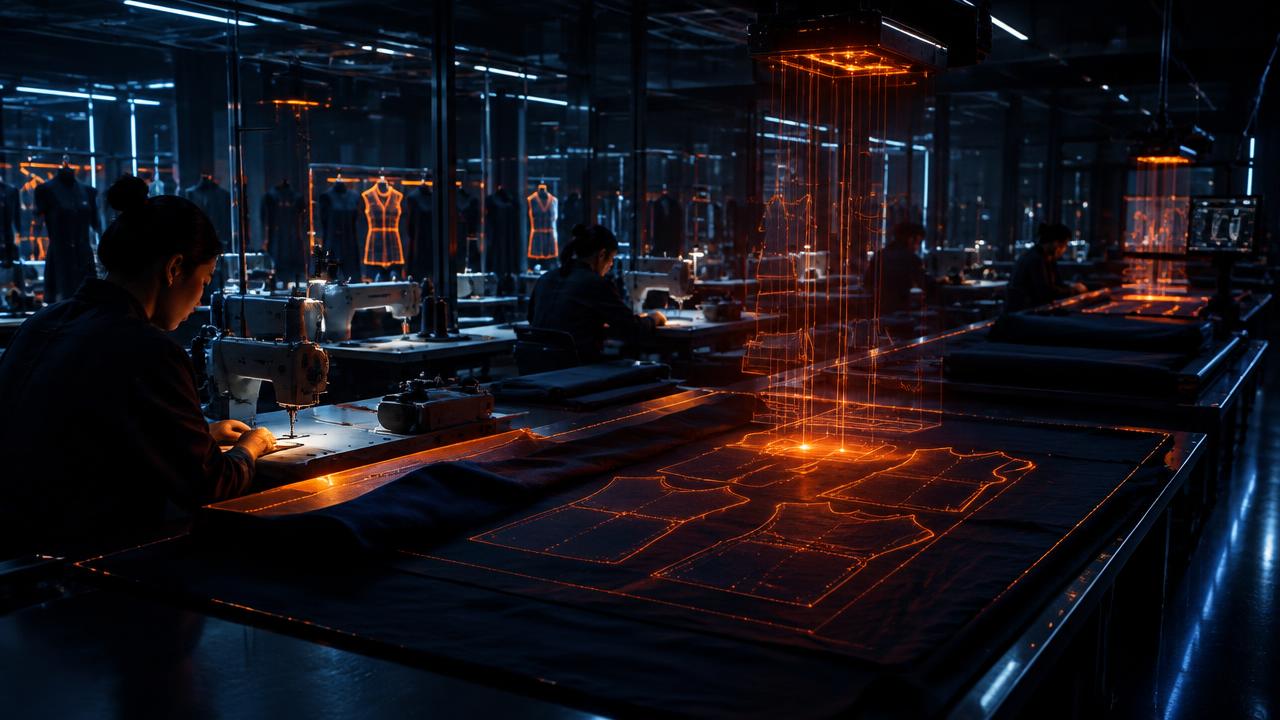
- Optimized Production: On the factory floor, AI-powered computer vision systems scan fabric rolls for defects before they're even cut, flagging flaws invisible to the human eye. AI-driven cutting tables, from companies like Lectra and Gerber, take a digital pattern and calculate the most efficient layout to minimize fabric waste, often reducing it to single-digit percentages.
- On-Demand Manufacturing: AI is the engine behind the shift to made-to-order production. A company like Unspun uses 3D body scans from a customer's phone to create a custom digital pattern for a pair of jeans, which are then cut and sewn on demand. This flips the traditional model on its head. Instead of "produce then sell," it's "sell then produce," eliminating inventory risk and waste entirely.
The Clear Advantages of the AI Approach
When implemented effectively, an AI-enhanced manufacturing process delivers powerful benefits. The most obvious is speed. Compressing the design and development timeline from months to weeks allows brands to be far more responsive to the market.
Precision is another critical advantage. Automated cutters don't get tired. Computer vision systems don't have an off day. This consistency leads to higher quality products and, most importantly, a dramatic reduction in material waste. The ecological and economic impact of using 10% less fabric on every production run is enormous.
Finally, AI enables adaptability. A traditional factory is set up for long runs of a single style. An AI-driven factory can pivot quickly. It can handle mass customization, where every item is slightly different, just as easily as a small batch of a new, experimental design. This flexibility is essential for surviving in a fragmented, trend-driven market.
The Head-to-Head Comparison
Placing the two models side-by-side reveals a series of trade-offs. What you gain in one area, you may sacrifice in another.
- Labor: The traditional model relies on a large, skilled manual workforce. The AI-driven model reduces the need for manual sewers and cutters but creates new demand for robotics technicians, data scientists, and 3D design specialists. It's not a question of eliminating labor, but of transforming it.
- Cost: Traditional manufacturing has high variable costs, primarily labor, which fluctuate with production volume. AI manufacturing has extremely high upfront capital costs for software, machinery, and implementation, but lower variable costs per unit once operational. This makes it a difficult investment for smaller businesses.
- Speed to Market: Here, there's no contest. The traditional cycle is measured in seasons. The AI-enabled cycle is measured in weeks or even days. This is perhaps the single greatest disruptive force AI brings to the industry.
- Customization: The traditional model excels at true, one-of-a-kind bespoke work but struggles to offer customization at scale. The AI model is built for mass customization. Think personalized sneakers from Nike or custom-fit T-shirts, produced efficiently in large volumes.
Challenges and Realities of AI Adoption
The transition to an AI-driven system is not a simple plug-and-play solution. The reality on the ground is complex and fraught with challenges that slow down adoption.
The biggest barrier is the investment. An automated cutting table can cost hundreds of thousands of dollars. A full suite of 3D design and PLM software is a significant recurring expense. For the thousands of small and medium-sized factories that make up the bulk of global production, this level of capital is out of reach.
There's also a major skills gap. You can't run a smart factory with a workforce trained for a traditional one. The industry needs a new generation of talent that understands both apparel construction and data science. That talent is scarce and expensive.
Finally, there's the "last mile" problem of automation: sewing. While cutting, logistics, and quality control are ripe for automation, the physical act of sewing remains incredibly difficult for a robot. Fabric is limp, stretchy, and unpredictable. Guiding two pieces of it through a sewing machine with the dexterity of a human hand is a monumental robotics challenge. Companies have been working on "sewbots" for years, but a commercially viable, versatile solution has yet to become mainstream. This means that for the foreseeable future, even the most advanced factories will still rely on human sewers.
The Hybrid Future: Blending Craft and Code
The debate over AI versus traditional manufacturing presents a false dichotomy. The future isn't a factory devoid of people, nor is it a wholesale return to old-world techniques. The most competitive and sustainable model will be a hybrid one, combining the best of both worlds.
In this hybrid factory, AI will handle the tasks it excels at: processing vast amounts of data for trend forecasting, optimizing fabric layouts to eliminate waste, and performing repetitive quality control checks. It will serve as a powerful assistant, augmenting human capabilities rather than replacing them entirely.
Human experts will remain at the heart of the process. Designers will use AI as a creative partner to explore ideas, but they will provide the final aesthetic judgment and cohesive vision. Skilled technicians will manage the complex machinery and troubleshoot production issues. And human artisans will perform the intricate sewing and finishing work that gives a garment its soul and lasting quality.
Imagine a designer using an AI to instantly simulate a new jacket design on a thousand different body types, ensuring a better fit before production even begins. Or a small brand using an AI-powered platform to connect with a factory for a small, on-demand production run, allowing them to compete with larger players without taking on massive inventory risk.
The factory of the near future isn't empty. It's a collaborative space where craft and code coexist. It's staffed by skilled people who are empowered by intelligent systems to make clothing faster, with less waste, and with a greater degree of creativity and personalization than ever before. That is the true remaking of clothing manufacturing.