The modern automobile is a marvel of engineering, a fusion of mechanical power and sophisticated software that’s more computer than carriage. But the revolution isn't just happening under the hood or in the dashboard; it's fundamentally reshaping the very place where cars are born. The factory floor, once the domain of rigid assembly lines and repetitive manual labor, is undergoing its most significant transformation in a century. The driving force behind this change is Artificial Intelligence.
AI in manufacturing is not merely an extension of automation. Traditional automation involves programming a robot to perform a single, repetitive task with precision. It’s a powerful but inflexible system. AI introduces a new paradigm: the ability to sense, learn, adapt, and optimize. It’s the difference between a machine that tightens a bolt and a machine that sees which bolt to tighten, determines the optimal torque based on real-time sensor data, and alerts a technician that the bolt feeder will need a refill in approximately 47 minutes.
This shift is creating a production ecosystem that is more efficient, less error-prone, and vastly more flexible than ever before. Let's explore the key areas where AI is streamlining the automotive production line.
The New Blueprint: AI in Design and Engineering
Long before the first piece of metal is stamped, AI is hard at work helping engineers design better vehicles. This initial stage is critical, as decisions made here have cascading effects on performance, cost, and manufacturability.
Generative Design
Generative design is a collaborative process between human and machine. An engineer defines the problem by inputting a set of constraints: this part must connect these two points, support this much load, be made from aluminum, and weigh no more than this amount.
The AI then explores thousands, or even millions, of design permutations, creating solutions that a human designer might never conceive. The resulting components are often organic and skeletal in appearance, using the absolute minimum material necessary to meet the required performance specifications.
The benefits are twofold. First, it leads to lighter, stronger parts, which is crucial for improving fuel efficiency in traditional vehicles and extending the range of electric vehicles (EVs). Second, by minimizing material usage, it reduces both cost and waste, contributing to more sustainable manufacturing.
Simulation and Digital Twins
Building physical prototypes is a time-consuming and expensive part of vehicle development. AI-powered simulation is drastically reducing this reliance on physical models. Carmakers now create "digital twins"—highly detailed virtual replicas of a vehicle, a component, or even an entire production line.
AI algorithms can then run countless simulations on this digital twin, testing everything from aerodynamics and crashworthiness to the performance of the powertrain under extreme conditions. Crucially, AI can also simulate the manufacturing process itself. It can predict how a specific part will behave during stamping, identify potential bottlenecks in the assembly sequence, or determine the most efficient path for a welding robot before the physical line is even built. This ability to "front-load" problem-solving saves immense amounts of time and capital.
The Intelligent Assembly Line
The assembly line is the heart of car manufacturing, and it's where AI’s impact is most visibly felt. Here, AI empowers robots and optimizes the flow of work with a level of granularity previously unimaginable.
AI-Powered Robotics
The robots on a modern assembly line are a far cry from their predecessors. Equipped with advanced sensors and computer vision, they can perceive their environment with stunning accuracy.
- Adaptive Manipulation: Traditional robots require parts to be presented in a precise orientation. An AI-powered robot, using computer vision, can identify a part from a mixed bin, calculate its orientation, and adjust its grip to pick it up correctly. This "bin-picking" capability dramatically increases flexibility and reduces the need for expensive, custom part-feeding machinery.
- Collaborative Robots (Cobots): These smaller, AI-equipped robots are designed to work safely alongside human operators. A cobot might hand a technician the correct tool, hold a heavy component in place while it's being fastened, or perform a strenuous, repetitive task, freeing up the human worker for more complex, cognitive work like final inspection or problem-solving.
- Precision Tasks: AI enables robots to perform intricate tasks that require real-time feedback. For instance, a robot applying sealant can use a vision system to ensure the bead is of a consistent thickness and follows a complex path perfectly, adjusting its speed and pressure on the fly.
Process Optimization
A car factory is a complex system with thousands of interconnected processes. Even a small delay at one station can create a significant bottleneck downstream. AI acts as a central nervous system for the entire production line, constantly analyzing data from sensors embedded in machinery, robots, and logistics systems.
By processing this torrent of data, AI can identify patterns and inefficiencies that are invisible to human managers. It might suggest re-sequencing assembly tasks to balance the workload, re-routing automated guided vehicles (AGVs) to avoid congestion, or subtly adjusting the speed of a conveyor belt to maximize throughput without compromising quality. The result is a self-optimizing factory that is constantly learning and improving.
The Unblinking Eye: Quality Control Reimagined
Maintaining consistent quality across millions of components is one of the greatest challenges in automotive manufacturing. Human inspection is vital, but it can be slow, subjective, and prone to fatigue. AI is a powerful ally in the pursuit of zero-defect production.
Visual Inspection with Computer Vision
High-resolution cameras paired with sophisticated AI models can spot defects with superhuman accuracy and speed. These systems are trained on vast datasets of "good" and "bad" examples, allowing them to identify flaws that are often invisible to the naked eye.
Common applications include:
- Paint Finish: Scanning every square centimeter of a car's body for minuscule blemishes, dust particles, or variations in color.
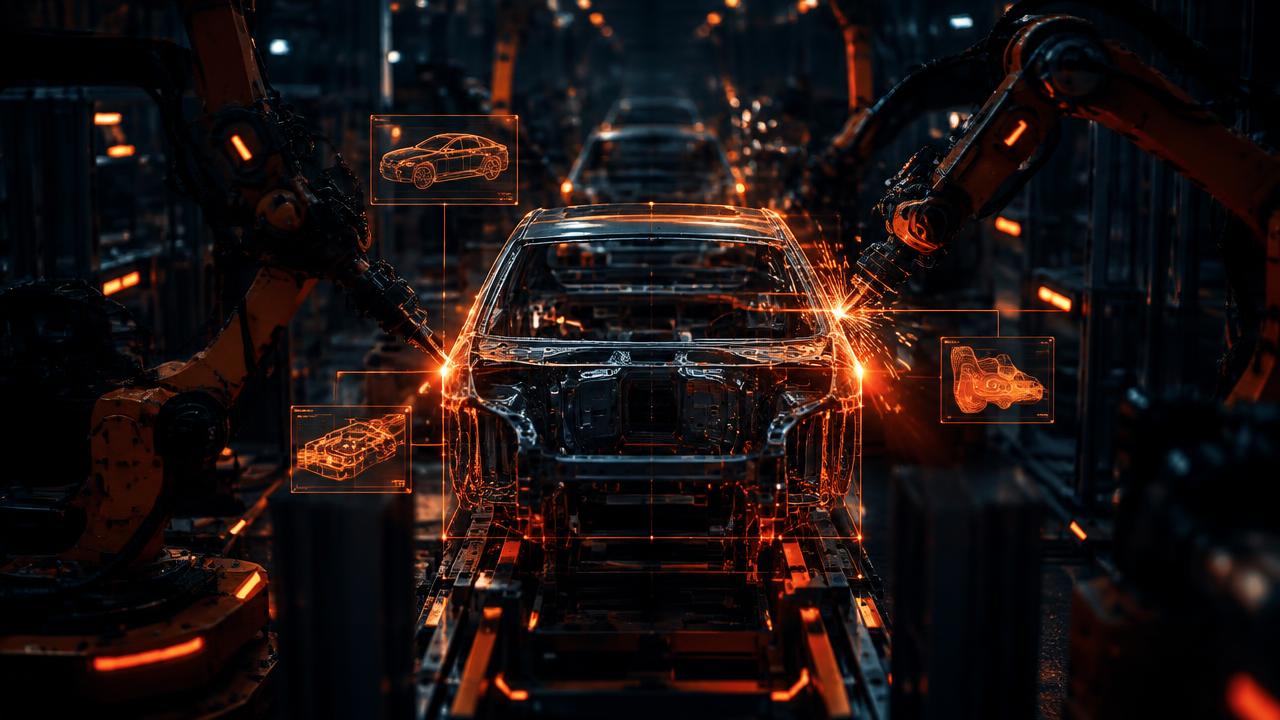
- Weld Integrity: Analyzing the thermal signature and surface geometry of welds to ensure they are strong and consistent.
- Component Verification: Ensuring every part is correctly installed, every connector is seated, and every label is perfectly placed.
Unlike a human inspector, an AI system never gets tired, never has a bad day, and can perform its check in a fraction of a second, 24/7.
Acoustic and Vibrational Analysis
Some defects aren't visible at all. An internal flaw in a transmission gear or a microscopic crack in an engine block might only be detectable by how the component sounds or vibrates under stress.
AI is being used to power advanced non-destructive testing methods. Microphones and sensors capture the acoustic signature of a running engine, a spinning axle, or an engaged electric motor. The AI, trained on the sound of thousands of perfect components, can instantly detect subtle deviations in frequency or amplitude that signal a hidden problem. This "listening" ability allows manufacturers to catch critical internal defects before a faulty component is ever installed in a vehicle.
Predicting the Future: The Rise of Predictive Maintenance
Unplanned downtime is the enemy of any manufacturing operation. When a critical machine on the assembly line fails, the entire production process can grind to a halt, costing millions of dollars per hour.
Traditionally, maintenance has been either reactive (fixing things after they break) or preventative (servicing things on a fixed schedule, whether they need it or not). AI enables a far more intelligent approach: predictive maintenance.
Sensors on factory equipment—from stamping presses to robotic arms—continuously stream data on temperature, vibration, pressure, and power consumption. An AI model analyzes this data in real-time, learning the normal operating signature of each machine. When it detects a subtle deviation that indicates impending failure—a slight increase in a motor's temperature, a new high-frequency vibration—it can alert maintenance crews well in advance.
This allows technicians to schedule repairs during planned downtime, order the necessary parts ahead of time, and prevent catastrophic failures. Predictive maintenance minimizes costly interruptions, reduces maintenance costs by avoiding unnecessary servicing, and improves overall factory safety.
Challenges and the Human Element
The transition to an AI-driven factory is not without its hurdles. The initial investment in sensors, data infrastructure, and AI software can be substantial. Furthermore, integrating new AI systems with legacy factory equipment is a complex technical challenge.
Perhaps the most significant challenge is the human one. The rise of AI does not mean the end of human jobs in manufacturing; it means a shift in the skills required. The need for manual, repetitive labor will decrease, while the demand for "new-collar" workers—robotics technicians, data scientists, AI system managers, and maintenance specialists—will surge. Automakers and governments must invest in training and reskilling programs to prepare the workforce for the factory of the future.
Driving Towards Tomorrow
Artificial intelligence is no longer a futuristic concept in automotive manufacturing; it's a practical and powerful reality. From the initial design sketch to the final quality check, AI is creating a more intelligent, agile, and efficient production ecosystem. It enables automakers to build more complex and higher-quality vehicles faster and more sustainably than ever before.
The car of the future will be defined by connectivity, autonomy, and intelligence. It's only fitting that it will be built in a factory that embodies the very same principles. The assembly line is becoming a living, learning organism, with AI as its brain—and it's driving the entire automotive industry toward an unprecedented era of innovation.